As a fresh-faced 21 yr old, I did a one-year placement at a pharmaceutical company as a synthetic chemist – a position that involves a lot of what is remarkably like cooking but with ‘reagents’ (fancy word for chemicals) instead of ingredients, making potential drugs instead of cakes. I loved the placement, I loved the work and I loved the people so I set about on the pathway to getting back in to the industry. It’s eight years on, I have the qualifications to do the role, I’m applying for jobs and I’m starting to wonder ‘Is this what I want to do? and 'Can I use all the skills I've learnt elsewhere?’

This blog is going to cover my research into what scientists like me are qualified to do that’s not in the laboratory. I’ll do my best to reference websites and people that actually do these jobs and hopefully I can help some people out by sharing what I’m learning. It’ll probably be interspersed with anecdotes and rants from the lab so you can see why I'm leaving this ‘unique’ environment! If you read this, think it’s useful/funny/worth reading, pass on the link – I’d love to know if I’m any good at this writing lark.

Showing posts with label Museums. Show all posts

Tuesday, 18 March 2014

I got a JOB! AKA a positive control for CV writing...

It finally happened. I applied for something great, I went through two interviews and, after a bit of contractual bartering, I'm starting next Wednesday! In the job application and job-finishing frenzy I haven't kept anybody up to date on what's been going on but here's what happened.

On the 19th February I applied for a volunteer role at the Natural History Museum only to find out that I'd mistakenly got the date wrong and applied one day too late! I was understandably miffed so I went into my flagged e-mail list to make sure I didn't miss any more deadlines.

I noticed that I still had one day to apply for two great internship roles at Sense About Science. Their name has come up a number of times when people were recommending employers to me so I wasn't going to let this one slip away. They make it their mission to help people understand the science they are bombarded with every day. This could be clearing up something confusing (or wrong) in the media, training scientists on how to best describe their own work or encouraging people to simply ask for evidence when given a piece of information.


Look! Dara O'Briain thinks their Ask For Evidence campaign is great!
I applied for two roles that were different in practice but similar in the skill-set required. They were Campaign Support Officer and Project Support Officer. Honestly, I put the applications together in half an hour and sent them. I did tailor each CV and cover letter to the roles but I didn't have to do too much work as this organisation (charity, actually) seemed to fit exactly what I wanted. I was really busy the next day at a TV masterclass (more on that in the future) but just two days later they asked me to come in for my interview the following week.

I had to submit a form and a written exercise beforehand and the interview itself only lasted 45 minutes. Nonetheless, I felt really pleased with the way it went. I didn't 'fake' anything or pretend to be anything I'm not and we all got on really well. There was even an awkward, but nice, moment where I had to namedrop that I'd been on Newsnight a few weeks before.

The follow-up interview with the managing director was the next week, where we discussed the role and the company in a bit more detail. Again, I felt very honest, I felt that they were being honest with me and there was no pretence. I was very excited. I still am.

Today, I wanted to pass on the great feeling that comes when you get a job you want, a job you know you can do well and (although I was sick of people saying it to me) when it's the right job for you, you WILL get it. Also, my 'positive control' CV was tinkered with in 10 minutes and sent out with a cover letter in just 30, but I've spent 18 months writing dozens of applications so I think I must've got pretty good at it! When it comes to the interview process, I've learnt that if you feel under a whole amount of pressure to 'perform' and be someone you're not, then the job is probably not for you. If you get the job under the pretence of a skill you don't really have or a type of personality that isn't really you, then the job is going to be very very stressful trying to keep that up!

Anyway, it's been a couple of weeks now but my contract is signed and I'm due to start next week, just a month after I applied. The whole process has raised quite a few issue of job-seeking including contract negotiations, juggling two jobs (I'll be at King's one day a week sometimes) and starting at the bottom, not to mention taking a huge (-60%) pay-cut. I'm hoping to share how this is all going over the next few weeks, with honest advice and tips for such a big life change.

I've also got some research to share on (science) writing and journalism. Just because I've found my niche (I hope), it won't stop me sharing my science careers stuff with you!

Oh yeah, If you're interested in the science communication side of the posts I've written, I'm writing on another blog called Experiments in Communication on the Speakers of Science network. That's more about what I'm learning about scientific communication from courses and as I go through my new career (job?)- Feel free to take a look. The other posts on the network are pretty cool too - one has a see-through egg!

Wednesday, 15 January 2014

The kindness of strangers

I wanted to write this post as a kick up the bum to anyone who is stuck in a rut and a thank-you to all the lovely people* who helped me try something completely different last week.

A few weeks before Christmas I tweeted that I was applying for lots of public facing science-based stuff…
Out of the blue, @Science_Grrl got in touch and said they’d happily put me in touch with someone in London who might be able to give me some careers advice/tips. I’ve never had anything to do with Science_Grrl. They’re an organisation that is fundamentally focused on fairness in society and this is manifested around the encouragement and promotion of girls and women in STEM (Science, Technology, Engineering and Mathematics) sectors. Of course, my situation fits the bill but I didn’t expect help from complete strangers in this way.

After work, on a Tuesday in the new year, I met up with their contact. Again, this person* had no obligation to help me out and yet they were spending extra hours after their working day to listen to me and give really helpful advice and words of support. It turned out that I’d met this person at a conference and that helped break the ice (I’d inadvertently stolen her friend's phone and she helped me give it back). She was really knowledgable about the area and very friendly. Apart from encouraging some of my ideas, she also suggested that I get in touch with all the departments at my institution that deal with public engagement. Her recommendation was that whilst internships and jobs are competitive, a good way to get some insight into new careers is to simply go and see what people do for a day.

The next morning I had a meeting with the Head of Department about setting up a blog and Twitter account for the department (something I’d not had the courage to bring up before) and sent out emails to Outreach, Public Engagment, Widening Participation and our Marketting department. I basically set out my interests, who I was and asked if I could perhaps spend a day shadowing them. Most got back to me pretty quickly with suggestions of who else I should speak to or explanations that watching them work would not be that exciting. However, our (lovely) public engagement department informed me that although watching them read and send hundreds of emails would be quite dull, I could potentially sit in on their following day of meetings with the Francis Crick Institute (aka 'The Crick') the next day. The Crick is a consortium of research organisations that will investigate cutting edge medical research as a partnership. Eventually they'll be based in King's Cross, London, but before they've built the institute itself they are running the Science Museum Lates in February and, as one of the Crick’s partners, some KCL research groups are presenting their work to the public. After checking with all the involved participants, I was allowed to ‘lurk’ at these meetings. This was quite exciting for me as the Science Museum has featured rather heavily in some recent life choices! I won’t spoil the surprises but there’s going to be some really exciting and entertaining work demonstrated at the event and I’d urge you all to go. It will be focussed on the future of biomedical discovery and will therefore be relevant to everyone as new advances and developments in medicine will effect us all, scientist or not.

During my public-engagement-sponsored loitering, not only did I get an insight into some of the varied work going on at my institution, something that is often surprisingly rare, but I also got to understand more about the logistics of such big public engagement projects.

The KCL public engagement department representative* wasn’t just there as a mediator but asked insightful questions to ensure that the real scientific messages weren’t lost in attention grabbing (but scientifically dubious) titles and experiments. Fundamentally, their experience lies in these events and they made sure that the researchers kept ‘on-message’ for the event and didn’t just present their research how they wanted to. This is a key point: If we want to discuss our reseach with the public, which I think we should, then we need to come at it from their point of view – What do they want to know about it? What are the key messages for them? This will probably not be them same as the key messages you want to get across for a journal but more general, although more concise and more about, dare I use the word, the impact of your research – i.e. Who cares?

A lot of question at the meetings focussed on logistics – Will I be on a stage looking down towards an audience or on one level? What equipment do you need? How many electrical sockets can I have? These questions were all tied up in how they could best present their ideas tailored to the event. It’s all very well to have an elaborate set-up but, if you have 45 minutes to prepare and it all needs to come home with you on the tube, you might rethink your plan to erect an intricate version of the large hadron collider made entirely out of cheese…. (BTW:I would fund this and would recommend halloumi - sculptable yet with some 'give')

With less than 90 minutes between meetings, the representatives from the Crick hotfooted it back to their offices in Euston on the bus and then all the way back to Waterloo. I got the impression that they’re really busy and commited to pouring their efforts into making this a very exciting event (see previous comment about 'You should definitely go').

In one meeting, I finally met a member of staff* who is heavily involved in all things public engagement/outreach-y in my wider department. She was exhausted from her involvement in getting an experiment sent into space the night before but was full of energy and enthusiasm for her next project. Before I’d left, she’d offered to let me get involved in another outreach event in March – timed to ensure that I could still be involved if my contract doesn’t get extended. Yet again, someone was going out of their way to help me and give me some advice. I was really touched.

I spent my lunch break meeting a Twitter-friend* (in person!) who gave up their lunch break to talk about our similar situations. Eye-opening and  helpful for both of us, I had planned to not be in the lab but everyone I spoke to that day had not expected to have me drop in unannounced and uninvited and yet had still made time for me.

Throughout the day I did my best to interfere as little as possible. It was difficult not to ask questions and comment and I did give in and interject here and there, when I thought it was appropriate.  I was really pleased to see the enthusiasm from some corners regarding public engagement within the university and it’s great to see that King’s is doing it’s bit to make sure that people know who we are and what we do. It was quite obvious that there are some people who do an awful lot of public engagement activities. And then there are the others. That seems to be a recurrent issue and there’s no point in making people do public facing activities that aren’t interested in doing it. This attitude will come across when they speak to people and won’t help anyone. However, what I’d like to see, in my department and university, and at others, is more awareness internally of what is going on. I had no idea that we were involved in experiments in space or that we’d been at Pint of Science. Our public engagement team do a great job in connecting those who can do public engagement with the event organisers but they’ve said themselves that they have to use their contacts in departments to get things done. This means that the same people end up doing the events time and time again. If students and staff realised what was going on both department and university wide, and supervisors realised the power of public engagement as a way of re-energising and training their students/staff (and not as a favour for ‘letting them out of the lab’) I think this would benefit everyone. The usual suspects would be able to turn things down and get some sleep, the rest of us could pick up the slack and learn something new, and even the university benefits from getting its ‘face’ out there. I’d also hope that some of us might remember why we started in these careers - We actually like science!

My 'take home message' today is that if your interested in doing some work with the public, be that at schools, museums or festivals, tell your public engagment department, tell your Head of Department and pretty soon you'll probably find an exhausted (but fulfilled) member of staff who's more than happy to let you help.

Anyway, I've got to go, I've got an event to plan...


N.B. If you're already doing something with the public, make sure your institution knows about it as well, a big problem for co-ordinating this sort of work is that we tend to keep things 'extra-curricular' under our hats. By doing this, you make it seem like it's unusual and not worthy of promotion.


*I haven't named the kindly folk who helped me out this week as I don't want them to be inundated with requests for help that they will be too nice to turn down. Also, they're my friendly strangers - get your own!

Tuesday, 7 January 2014

Robots made me do it...

I turned down a job last month. 

Those of you who've followed this blog or (God forbid) know me personally, will know that I've been actively looking for a new job for well over a year, with absolutely no luck, so this was a big deal for me and may come as a bit of a surprise for you.

It was great job that would pay well, working for someone I really respect, so I think I should probably explain myself. I'll get to the robots in a bit...

The job was a research post with great opportunities to develop my career in a dynamic group keen to make big steps quickly - potentially with the resources and enthusiasm to actually meet these goals. In academia, things can move very slowly, one reason why I've always wanted to work in 'industry' - a catch all term that researchers use to describe jobs that makes a commercial product, rather than academia, where the research is usually more driven by the desire to learn (this is changing, but that's for another time...). This post would put me in a great position to go into industry in 2 years, maybe a little longer.

The cherry on the employment-cake was that I'd also get to work for an ex-boss that I liked, knew our work styles were compatible and I was confident we could do good research together. All of these positives were why I applied, why I was pleased when I went for my interview and why I left the enjoyable interview with a spring in my step.

I was told that it might be a while before I heard back about the job and that they'd let me know when they'd be able to 'let me know'. However, in the end, they got back to me quickly with an offer of a role. Looking back,  I think I probably knew straight away that something wasn't right. I felt really weird about the offer. Sad that I'd 'have' to take this job, that it was too good an opportunity to turn down, that all my investigations and inroads, however meagre, into life away from research was for nothing and that the decision had more or less been made for me by the offer of this great job.

Then, I realised something. If I was sad about taking the job, if I was sad to stay in research, I probably shouldn't do it! This sounds really daft, I'm sure. Of course this sounds like an obvious conclusion but it wasn't an easy decision to come to and I thought it might be helpful to others to explain how I got there...

I asked for a week to think about the offer. I don't think they were thrilled to wait but they'd been happy to tell me that I should expect a long wait and I think, as an interviewee, you should never forget that you are also interviewing them!

Over that week, I spoke to friends, family, current and past colleagues about my dilemma. If reading this, you are one of those people, then 'Cheers' - by getting things off my chest I started to come to some sort of decision about what I wanted to do, but I was still of the splintery-bum-brigade, not quite getting off the fence. For a number of complex reasons that I can't Athena Swan my way out of, the role would also involve a change of my personal plans for the next few years and I wasn't willing to commit to the job, or to turn it down, unless I was sure the role was worth making certain sacrifices for.

That week, I also went to a Science Museum Lates event. The theme was Robots. Pretty jazzy, I'm sure you can imagine. There were tiny cheetah robots, creepy salamander robots, robot hands and robot fish that could be controlled via a video game. In a word, it was excellent.

I sat on the floor and made a robot wasp. The wasp, on the other hand, was pretty poor (and I ruined a mascara trying to put stripes on it, oh the sacrifice!). Anyway, my point was, as I trundled around the museum, agog at the technology that others had designed, truly fascinated by the work and throughly engrossed in the best way to get my robot to beat my husband's in a race, I didn't feel inspired to run back to the lab to produce my own imagination-capturing-inspiring research. What I thought was, 'Wouldn't it be great to work here' (and the occasional 'I could've explained that better'). To talk about science to people who just want to learn about it, or who didn't realise they liked it and only came for the speed-dating, but stayed for the circuitry. The idea of that really grabbed me. I know one night on a special event, at one of the most well-known museums in a city known for it's museums, is hardly representative of the normal life of your public engagement/scientific communication/museum curating employee, but I was far, far more excited by the idea, the challenge and the opportunity to at least try to do something like this than I was of a certain job, well-paid, with the aforementioned great boss.

Fundamentally, I don't deserve the job. Somebody else will do that job well, somebody who will throw themselves into a research career, somebody who is hungry for this position - and that 'someone' is not me.

So, I guess, what I'm trying to say is I've come to a realisation:

When you're 19 and you're sure you want to do a job, when you spend years studying, learning and occasionally crying en route to that job, sometimes, ten years later, it might be OK to change your mind.

When I finish my twice-extended contract in less than three months, with no job prospects, I may live to regret this possible act of folly. Until then, anyone want to buy my robot wasp (the wings fell off in the race that I didn't win. I hope it's not a sign)?

Monday, 2 December 2013

'To do' list of a fledging scientific communicator...

As you may be aware from some of my earlier posts, I'm really interested in different ways of scientific communication - From museum events to blogging and twitter. After speaking to lots of different people I thought the only way I could see if I was even capable of writing on a regular basis was to try some writing, so I started this blog.

I've only been doing it a few months and ended up on a panel about blogging (much to the chagrin/confusion of true blog aficionados) so whilst I'm not exactly a 'big deal' (Ron Burgundy quote #1 of this blog, I hope not the last) I am trying to learn as much as possible. In order to see just how far I can push this idea in a short period of time I thought I'd turn my hand to a few other things to see just how I can best communicate my science, the science of others and the science of well, science. After discussing this amongst my colleagues, the general consensus was 'Hey, can we have that list too?' So, here it is:

1. Keep writing the blog...
Sometimes this is easier said than done, although I do enjoy it - I'd recommend starting one if it's something you think you might enjoy, you can write about anything you like - people read all sorts of rubbish when they're avoiding their tax returns, their kids and their actual jobs!

2. Practice communicating science to a 'lay' audience. 
Urgh, is there a more patronising word than 'lay'? Anyway, you know what I mean, talking about science to those who aren't scientists or don't work in that area of science. This could encompass journalism, blogging, teaching, museum work, comedy and all sorts, as I've recently learnt.


Competitions
I'm going to enter a couple of science writing competitions, one on 'translating' hard-core papers into 800 words of accessible text, and another more vague competition (also 800 words) that requires the writer to discuss the topic of Openness in Science - I'm not even sure I like the word 'opennes' but I'll give it a try.


Plain English Summaries
I want to add a few entries to Science Gist, a site where you can add simplified summaries of any papers you may have read. An additional bonus behind this is that a lot of people make summaries already in their own note-taking, so why not share it and see if what you write makes sense? 


Not-so-plain English Summaries
If you want to take plain English summaries a step further you can give UpGoer Five a try - this is a project where you describe anything you like (your job, your pet, Schrodinger's uncertainty principle) using just the top one thousand (or ten hundred to be 'in the rules') words. It's an extreme look at the use of jargon but it is surprisingly difficult and suprisingly entertaining to try and describe spaghetti bolognese without 'meat', 'beef' or 'cow'. It gets it name from the original project where a rocket scientist described his rocket (or UpGoer) using these rules in a popular comic (xkcd).


3. Get Political
Ok, not exactly, but I want to enter the poster competition that will be exhibited in the House of Commons. I think this will be a little different to the standard poster sessions scientists get involved in as it will involve communicating your work to a non-expert audience, not something you get chance to do often, is it? Or maybe you go to the House of Commons all the time. I doubt it, But maybe...

4. Get marks for attendance 
I'd like to get more of an idea of how science is communicated to the general public that's not via the written word so I've been taking advantage of living in central London and going to as many science events/seminars as I can fit in. Apart from Science ShowOff (science-based comedy, performance and juggling), I attended Science Uncovered at the Natural History Museum (and blogged about it here), Science Museum Lates at the Science Museum, attended a seminar on Science Gallery (and it's planned expansion to London) and also watched a heat for FameLab. I'm thinking of sending in a video entry. I may very well bottle it. 

At the Science Museum Lates, I bumped into a friend of a friend of a... you get the idea,  and we got to talking about the speed dating event that was happening at the museum. He commented 'Well, at least you know that the person you are going to meet will be of above-average intelligence.' I thought that was a bit sad (and not necessarily true) - I hope the (free) museums and their events in London are for everyone and not just those that deem themselves 'better than the rest'. To be honest, given the location of many of the museums in London, the only possible stereotype you could throw about is that the attendess might be richer than most. Or more likely to be called 'Cosmo' or 'Jacinta'. Both good names, by the way, but you get what I mean, I hope. (Funnily enough, I am planning to write a post on the people that actually go to the museums, but that's not for here and now).

5. Media Fellowships.
This is something I think I may have 'missed the boat' with, but I'd have loved to have heard about them during my PhD. There are lots of different media training opportunities available (listed on the BSA site here - British Science Association, not Bovine Serum Albumen, anyway...) but I've heard really good things from people who went on the Media Fellowship available from the BSA. you need to be still IN research, and contracted until the end of Dec 2014 to even apply for the 2014 places, something that's not an option for me, but I'd definitely give it a try if I could. It involves 3-6 weeks away from your research so your boss has to consent AND submit a letter of recommendation (i.e. you can't do it if they don't agree, it seems). For more information on working with/in/for the media, check out this page, again from the BSA.

5. Applying, applying
Basically I've upgraded from not getting well-paid positions that I'm not sure I want, to not getting lower-paid internships that I definitely want. I'd say to anyone else considering a similar move to mine (i.e. out of something where you've proven your experience, into something new) you're probably going to have to take a pay cut. This may seem like a pain to begin with, especially if, also like me, you're thinking of trying to buy your first house. In London. However, you are giving yourself a chance to try something new, internships are rarely very long and, if you can prove yourself, companies will usually keep people who've shown they are pro-active and keen enough to do an internship in the first place - so chin up, it's a bit of a cliche but I'd rather be doing something I actually liked!

I've recently found a new jobs board on the British Science Association (BSA), as well as a lot of pointers from Twitter and the PSCI-COM JISCMail. Actually, the BSA (again) has information on everything from  public engagement to graphic design on their Science in Society section - worth checking out. 

In other news
This week I applied for 3 jobs, 2 internships and turned down a well-paid, great opportunity job that I won't actually like doing (more on that later). 

Don't tell, will you?

Tuesday, 1 October 2013

Parasites, dolphin autopsies and space-dust. Standard friday night.


Picture the scene, it’s Friday night in a swanky part of London and John, ‘Curator of Molluscs’, comes out with ‘And that’s not the most extreme way of getting sperm into a lady’. If this sounds a bit weird, that’s because it was. 

Late on Friday afternoon I found out about an event called ‘Science Uncovered’ at the Natural History Museum in South Kensington, London (South ‘Ken’ to the locals/luvvies). As I’m getting increasingly interested in ways to discuss science and engage with the public, I thought I’d pop along before I went out on Friday night. I turned up 2 hours late for my night out, brimming with enthusiasm for other people’s research, trying to explain the beauty of parasites to my (now half-inebriated) friends in a (very hot) salsa bar near Leicester Square. As you can imagine, they didn’t represent the best audience so I thought I’d let you lot in on what you missed!

I arrived at the museum in a bit of a rush, determined to be in-and-out in 30 minutes. I was immediately greeted by a poll on ‘How important is science to everyday life?’ People were hastily cramming their voting tokens into the box marked ‘Very’ and trying to look knowledgable but not too keen – the standard ‘science face’. However, within minutes, it was impossible not to become drawn in to the exhibition. There were over 300 scientists discussing their work throughout the museum. For example, in the Earth Hall, earth scientists from Imperial were showing off the power of desktop scanning electron microscopes by using an ENORMOUS plasma TV to show pock marks on panels that they’d taken from the Hubble telescope after a meteor shower, and marine biologists were talking observers through a gruesome but extraordinary dolphin autopsy under the huge blue whale in the ‘Blue Zone’ for mammals. The whole thing was really informative and interesting and I’d actually encourage anyone who feels their interest in science waning to go and check out their late night events (I think the last Friday of the month is often dedicated to such one-off exhibitions).

It would take me hours to recount the whole event, so here are some highlights...

Being chatted up with – Is that your perfume or just your natural pheromones that smell so good? - Scientists really do know how to the woo the ladies…(It was Escada, Marine Groove, in case you were interested - I was quite sweaty from the tube and had over-applied it.)

Hearing science rubbish, like: ‘I would like the alphabet to consist of less letters. I feel we’re just collecting them…’


Left: Getting up close to some gross parasites (Taeniasis)


Right: Playing children's games to help explain extinction and  food chain disruption


 Below: Using an ENORMOUS plamsa tv to control the view of 'space-dust' from a desktop scanning electron microscope. 

Left and Right: Having a go at predicting the weather – actually quite difficult to point to the right bit of the screen!


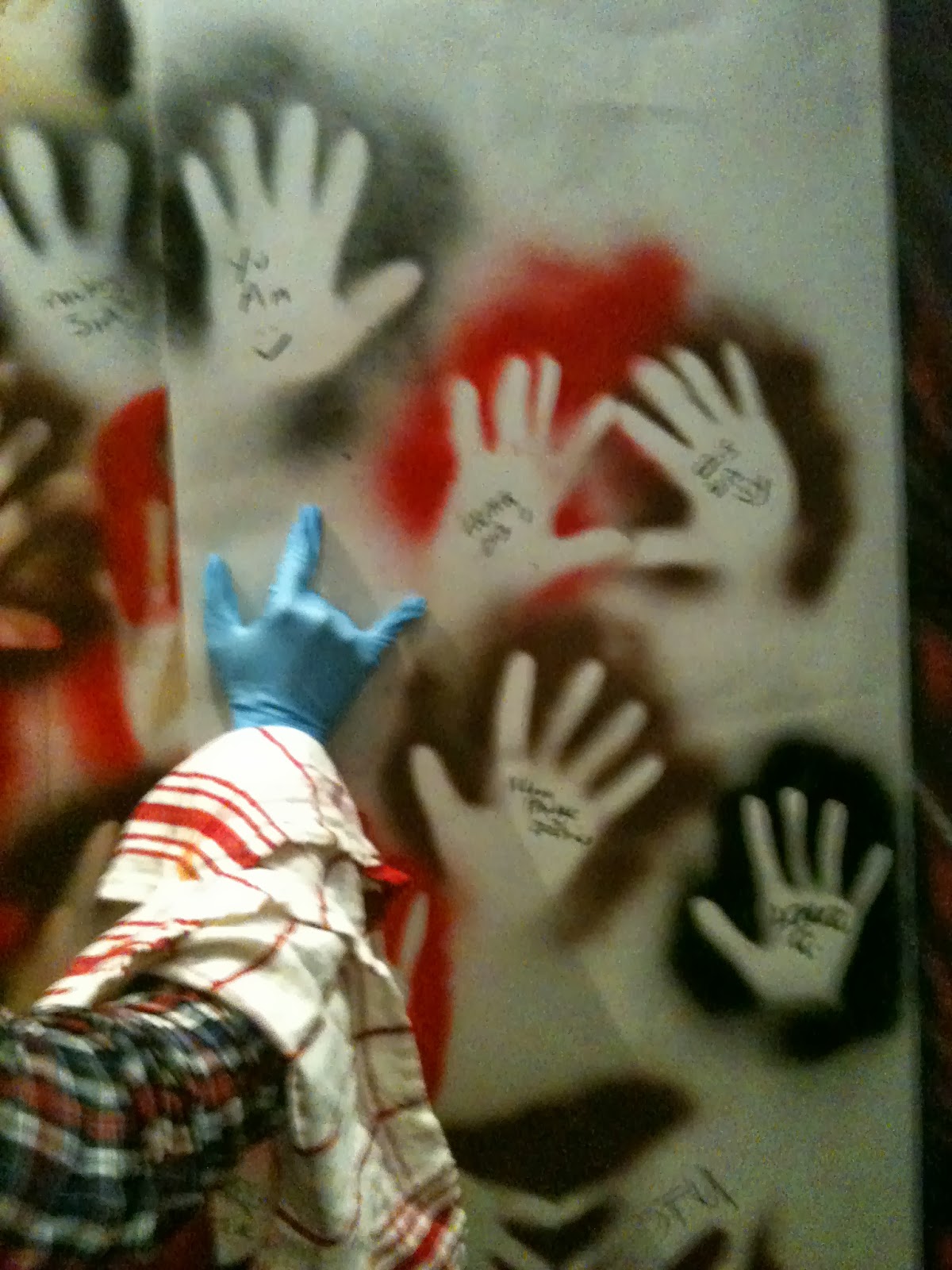
 Below: Making modern ‘cave paintings’...


Below: Marvelling at the cake-based representation of tectonic plates – who knew Iceland rendered in icing would be so delicious? (I think that's upside-down Chile/Argentina on the right)


Below: Listening to ‘Soapbox scientists’ discuss their given topic with anyone who would listen – and a few who would not - some 'interesting' questions...


Left: Learning about the ingredients in Gin (no free samples, sad times)


Below: Studying the beautiful art created from the patterns of nature, including wasps and coral


Comparing the ‘recovered’ foetuses of a hump back whale (large tank, below left) and a harbour porpoise (bottle, below left and close-up, right) at 6 months gestation.

Below: Playing with whale teeth!!Left: Blue whale baleen (krill filter); middle: whale tooth (can't remember the name, but you can count the rings to work out its age - just like a tree!); far left: Minky whale baleen.


Left: Watching the dolphin autopsy – apparently a major cause of death is internal heamorrage from male adolescents i.e. excited and horny teenage dolphins
 Finally, the most memorable stand consisted of pickled sea creatures and was run by John, the aforementioned ‘Curator of Molluscs’. He was obscenely passionate about his work and had a crowd of agog listeners within minutes. I will (poorly) recount some of his best facts.

-Sea creatures that can change colour are chromatophoric and they change their skin colour my inflating the minute patches of skin that display the colour they want to be. 

-Boy cuttlefish use this to get some cuttlefish action by pretending to be girls (so that the men don’t attack them) and then ‘seducing‘ the lady cuttlefish whilst their backs are turned (sneaky beggars).

-Some octopi have hectocotyli – an appendage that removes sperm from an internal penis and then ‘delivers’ it to the lady octopus. Nice.  

-There were weirder penis stories from the marine world involving the words ‘detachable’ and ‘sperm explosion’ but it wasn’t all phallus-related...

-We also learnt that the octopus beak is just that, a beaky monstrous thing that is so strong and sharp it’s being investigated by nanotech companies!

Another highlight was being shown Darwin’s ‘pet’ octopus that distracted him from his theories of evolution. Until he killed it and pickled it that is. Naturally.

Pickled octopus tentacle. Yum!
An octopus 'Beak'. Very nasty!
Throughout this weird and wonderful list I'm sure you can see that I thoroughly enjoyed my evening of other people's research. There were plenty of scientists, artists, kids and 'normal people' who all seemed to be enjoying themselves too! 

As I left via a side door, late for my evening of salsa and Mojitos, I was quite jealous of all the people I'd met that night who quite clearly love what they do...